
Understanding the Feline Mind
Cat psychology is the study of how cats perceive, process, and respond to their environment. Unlike humans, cats do not rely heavily on abstract reasoning or long-term planning. Instead, their behavior is shaped by instinct, sensory input, and learned associations.
A cat’s brain is highly specialized for survival, hunting, and environmental awareness. This means they excel at recognizing patterns, predicting movement, and responding quickly to stimuli.
Domestic cats have also developed a unique ability to adapt their behavior specifically to humans, which makes their psychology even more complex.
Understanding how cats think is essential for improving training, behavior management, and emotional bonding.
The Role of Instinct in Cat Psychology
Instinct is the foundation of all feline behavior.
Cats are obligate carnivores, meaning their survival historically depended on hunting small prey. This has shaped their brain structure and decision-making processes.
Hunting instincts influence almost every behavior, including play, feeding, stalking, and even curiosity.
Even when a cat is well-fed, the instinct to chase movement or investigate small sounds remains active.
These instincts are not learned; they are hardwired into feline psychology.
Learning Through Association
Cats primarily learn through associative learning, also known as classical and operant conditioning.
This means they connect actions with outcomes rather than understanding abstract rules.
For example, if a cat learns that meowing results in food, it will repeat the behavior.
If jumping on a counter results in punishment or removal, the cat may reduce that behavior over time.
Cats do not understand punishment in a moral sense; they only understand consequences linked to specific situations.
Consistency is therefore crucial in shaping behavior.
Memory and Cognitive Processing
Cats have strong short-term and long-term memory systems, especially for survival-related experiences.
They remember locations, routines, and emotionally significant events.
A cat may remember where food is stored, where danger occurred, or which humans provide comfort and safety.
However, their memory is highly context-based. A cat may behave differently in a new environment even if it has learned behaviors elsewhere.
This is why training must often be repeated in different settings.
Emotional Intelligence in Cats
Cats experience a range of emotions including fear, pleasure, frustration, anxiety, and contentment.
While they may not process emotions in the same way humans do, they clearly respond emotionally to environmental changes.
Cats can form strong attachments to humans and other animals.
They recognize emotional patterns in their owners, such as tone of voice, body language, and routine behavior.
This emotional sensitivity allows cats to adapt their behavior based on human reactions.
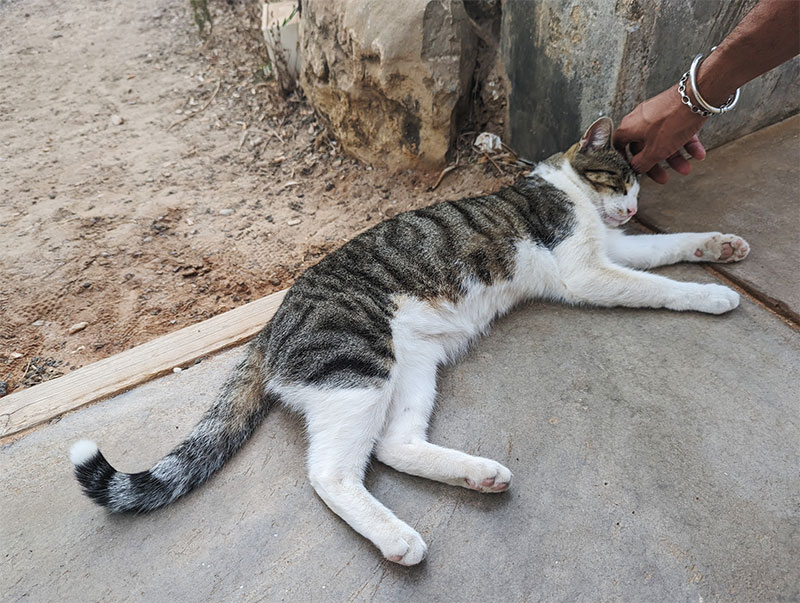
The Reward-Based Learning System
Cats are highly motivated by rewards rather than punishment.
Food, play, attention, and comfort are primary reinforcers in feline learning systems.
When a behavior leads to a positive outcome, the likelihood of repetition increases.
For example, if a cat receives treats after using a scratching post, it is more likely to repeat that behavior.
This system is known as positive reinforcement and is the most effective method for training cats.
Negative Reinforcement and Its Effects
Negative reinforcement in cats is often misunderstood.
Cats do not respond well to fear-based training methods such as yelling or physical punishment.
Instead of learning the desired behavior, they may become anxious, avoidant, or aggressive.
Fear can damage trust and reduce willingness to interact with humans.
Effective behavior modification focuses on redirecting rather than punishing.
Sensory Influence on Learning
Cats rely heavily on their senses when learning about the world.
Smell is particularly important in memory formation and environmental recognition.
Sight is used for detecting movement and spatial awareness.
Hearing allows cats to detect subtle changes in their environment.
Touch also plays a role in social bonding and comfort.
Learning systems in cats are deeply connected to sensory experiences.
Play as a Learning Mechanism
Play is one of the most important learning tools in feline psychology.
Kittens learn hunting techniques, coordination, and social boundaries through play behavior.
Even adult cats continue to use play to refine skills and release energy.
Play sessions simulate real hunting sequences: stalking, chasing, capturing, and biting.
This is why interactive toys are so effective in behavior training.
Habituation and Environmental Adaptation
Habituation is the process by which cats become accustomed to repeated stimuli.
Over time, cats may stop reacting to non-threatening sounds, objects, or routines.
This allows them to conserve energy and focus on relevant environmental changes.
However, sudden changes can still trigger stress responses even in habituated cats.
Consistency in environment helps maintain emotional stability.
Problem-Solving Abilities
Cats are capable of basic problem-solving, especially when motivated by food or curiosity.
They can learn to open doors, manipulate objects, and navigate complex environments.
Puzzle feeders are often used to engage this cognitive ability.
Intelligent breeds may show more advanced problem-solving skills.
However, cats typically solve problems through trial-and-error rather than planning.
Territorial Learning Systems
Cats mentally map their environment to establish territory boundaries.
They learn safe zones, feeding areas, hiding spots, and observation points.
Changes in environment require re-learning and adaptation.
This territorial awareness influences stress levels and behavior consistency.
Vertical space is especially important for psychological comfort.
Social Learning in Cats
Cats also learn by observing other animals, including humans.
In multi-cat households, younger or less confident cats may copy behaviors of more dominant cats.
Cats can also learn routines by watching human actions such as feeding schedules or door usage.
However, social learning is less dominant than individual associative learning.
Stress and Cognitive Overload
When cats are exposed to excessive stimulation or unpredictable environments, they may experience stress.
Stress interferes with learning ability and memory retention.
Common signs include hiding, aggression, overgrooming, or loss of appetite.
Reducing environmental chaos improves cognitive performance and emotional stability.
Reinforcement Timing and Effectiveness
Timing is critical in cat learning systems.
Rewards must be given immediately after desired behavior for effective association.
Delayed reinforcement reduces learning efficiency.
This is why consistent, immediate feedback is essential in training.
Individual Personality Differences
Every cat has a unique psychological profile.
Some cats are highly curious and motivated by exploration.
Others are cautious and prefer predictable routines.
These personality differences affect learning speed and training methods.
Successful behavior training must be adapted to individual temperament.
The Role of Environment in Behavior Formation
Environment plays a major role in shaping cat psychology.
Enriched environments promote positive behavior and mental health.
Boredom often leads to destructive behaviors such as scratching furniture or excessive vocalization.
Providing stimulation reduces unwanted behavioral patterns.
Human-Cat Communication Systems
Cats learn to interpret human behavior over time.
They associate voice tone, gestures, and daily routines with outcomes.
Many cats learn specific human cues such as feeding preparation sounds or door movements.
This interspecies communication strengthens bonding and behavioral predictability.
FAQ
Do cats understand training like dogs?
Cats learn differently, mainly through association rather than obedience-based systems.
Can cats remember commands?
They can remember associations but may not respond consistently like dogs.
Why is my cat not responding to training?
Inconsistent reinforcement or lack of motivation is often the cause.
Do cats learn from punishment?
Punishment is ineffective and can damage trust.
Are cats intelligent animals?
Yes, cats are highly intelligent but in a different way than humans or dogs.
Conclusion
Cat psychology is based on instinct, sensory input, and associative learning rather than abstract reasoning. Understanding feline learning systems allows owners to train cats effectively using positive reinforcement, environmental enrichment, and consistent routines. When properly understood, cats reveal a highly adaptive and intelligent psychological system shaped by both evolution and human interaction.